Cleaner Pulp Bleaching with Laccase
<p>Pulp bleaching still depends on a difficult balance between <strong>brightness, chemical load, cost, and environmental performance</strong>. Laccase offers a cleaner biological route to support delignification, and a high-temperature microbial enzyme makes that route more practical for industrial bleaching trains.</p>
Why pulp bleaching is still a chemical balancing act
Kraft pulping separates cellulose fibers from wood by removing much of the lignin that binds the plant cell wall together. But the process does not remove all of it. The remaining lignin is what gives unbleached kraft pulp its brown color, and it must be reduced further when the target is bright paper, tissue, packaging, or specialty cellulose.
That final brightness is achieved through a bleaching train: oxygen delignification, chlorine dioxide, peroxide, ozone, alkaline extraction, washing steps, and other combinations depending on the mill. Modern mills have moved far away from elemental chlorine, and elemental-chlorine-free bleaching is now the dominant industrial standard (Stora Enso, 2017). Still, bleaching remains one of the most chemically intensive parts of pulp production.
The challenge is not simply to make pulp white. It is to remove or modify residual lignin while protecting cellulose strength, controlling cost, and reducing the environmental load of the process. That is where enzyme-assisted bleaching becomes interesting.
Why mills keep looking for cleaner bleaching steps
The pulp and paper industry has spent decades reducing the environmental impact of bleaching. Elemental chlorine has largely been replaced by chlorine dioxide and oxygen-based chemistry, and totally chlorine-free sequences are used in selected mills (Stora Enso, 2017). These changes have been important, but they do not eliminate the basic tension: higher brightness usually demands more chemistry, more energy, or more process time.
A cleaner bleaching step is valuable when it shifts that balance. If a pretreatment can make residual lignin easier to remove, the following chemical stages can work more efficiently. If the same brightness can be reached with a lower chemical burden, the mill gains environmental margin and operational flexibility. If effluent color or organochlorine load can be reduced, the benefit extends beyond the bleach plant into wastewater management and permitting.
This is the practical sustainability case for laccase. It is not a slogan about replacing a mill’s chemistry overnight. It is a targeted way to make an existing bleaching train cleaner.
What laccase does in pulp bleaching
Laccase is a copper-containing oxidase. It uses oxygen as the final electron acceptor and oxidizes phenolic structures in lignin and lignin-related compounds (Virk et al., 2012). In pulp bleaching, the goal is to modify residual lignin so that it becomes easier to remove in later extraction or bleaching stages.
Because lignin inside pulp is chemically complex and not always directly accessible, laccase is often discussed together with a mediator. In a laccase-mediator system, the enzyme oxidizes a small mediator molecule, and that oxidized mediator can diffuse into the fiber matrix and attack lignin structures that the enzyme itself may not reach efficiently (Singh et al., 2015).
That mechanism is not theoretical. In a representative kraft biobleaching study, laccase combined with the mediator ABTS lowered the kappa number of eucalyptus kraft pulp and increased its ISO brightness, demonstrating bacterial laccase suitability for industrial pulp applications (Arias et al., 2003).
That mechanism explains both the promise and the caution. Laccase can support delignification and brightness improvement, but its performance depends on the mediator, pulp type, pH, temperature, residence time, and the downstream extraction sequence (Singh et al., 2015). In other words, laccase is not a generic additive. It is a process step.
Why laccase has not been trivial to deploy
The scientific case for laccase-assisted pulp bleaching is strong, but the industrial case depends on details. Reviews of laccase-mediated biobleaching repeatedly point to the same bottlenecks: mediator cost, enzyme stability, process pH, temperature, redox potential, side reactions, and large-scale production economics (Singh et al., 2015).
Temperature is particularly important. A pulp mill does not operate like a benchtop assay. Process streams are warm, variable, and expensive to cool. Many fungal laccases perform well in laboratory conditions but lose practical value when the mill has to adjust temperature, pH, or residence time too aggressively to keep the enzyme comfortable (Virk et al., 2012).
That is the familiar problem with industrial enzymes: the biology works, but only inside a narrow window. When the process has to bend too far to accommodate the enzyme, the sustainability advantage starts to erode.
Why a thermophilic laccase changes the conversation
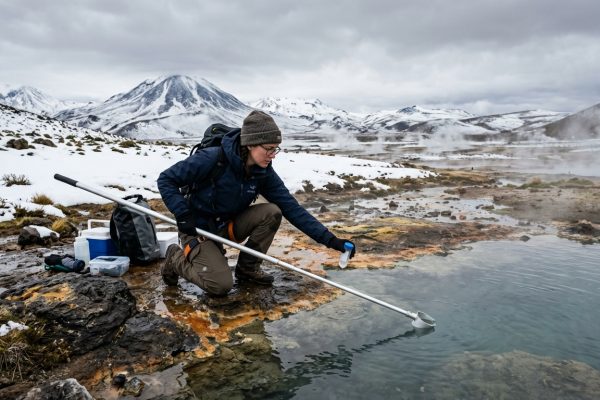
Swissaustral’s laccase is derived from a thermophilic microorganism and produced recombinantly in E. coli. Its product specification lists a temperature range of 30 to 100 °C, with an optimum at 80 °C, and a pH range of 5.5 to 7.5. The enzyme maintains over 60% activity for two hours at 70 °C, and the product datasheet reports approximately 75% activity after six hours at 60 °C.
Those numbers matter because they address one of the central implementation barriers for laccase in pulp bleaching: stability under real process conditions. A laccase that tolerates elevated temperature can be integrated closer to the operating reality of the bleach plant, reducing the need to over-cool a stream simply to make an enzymatic step possible.
The value is not that temperature stability solves every challenge. Mediators, pulp type, sequence design, and economics still matter (Singh et al., 2015). The value is that a thermophilic microbial laccase removes one of the reasons enzyme-assisted bleaching often remains trapped at the laboratory stage.
Where laccase fits in a real bleaching train
The most practical way to understand laccase is as a cleaner supporting step before or between conventional bleaching stages. It can help oxidize residual lignin, improve downstream extractability, and reduce the chemical intensity needed to reach a target brightness (Virk et al., 2012).
For a mill, that means the relevant question is not whether laccase replaces chlorine dioxide, peroxide, oxygen, or extraction chemistry. The better question is whether laccase can reduce the burden placed on those stages while maintaining pulp quality. That is the kind of question that can be tested in a pilot sequence, with real pulp, real brightness targets, and real effluent constraints.
A cleaner route to brighter pulp
Pulp bleaching will remain a carefully controlled industrial sequence, not a single-reagent problem. But that is exactly why laccase is useful. It gives mills a biological lever inside a process that is otherwise dominated by chemical oxidants, and it does so with oxygen as the final electron acceptor.
Swissaustral’s Laccase (LAC) is built for the temperature conditions that make pulp applications demanding. For mills evaluating cleaner bleaching routes, the enzyme offers a practical starting point for testing laccase-assisted delignification under industrially relevant conditions. Learn more about Swissaustral Laccase (LAC) →
References
Arias, M. E., Arenas, M., Rodríguez, J., Soliveri, J., Ball, A. S., & Hernández, M. (2003). Kraft pulp biobleaching and mediated oxidation of a nonphenolic substrate by laccase from Streptomyces cyaneus CECT 3335. Applied and Environmental Microbiology, 69(4), 1953–1958. https://pmc.ncbi.nlm.nih.gov/articles/PMC154780/
Singh, G., Kaur, K., Puri, S., & Sharma, P. (2015). Critical factors affecting laccase-mediated biobleaching of pulp in paper industry. Applied Microbiology and Biotechnology, 99(1), 155–164. https://doi.org/10.1007/s00253-014-6219-0
Stora Enso. (2017). Pulp bleaching fact sheet [Fact sheet]. https://www.storaenso.com/-/media/documents/download-center/documents/sustainability/pulp_bleaching_fact_sheet_2017.pdf
Virk, A. P., Sharma, P., & Capalash, N. (2012). Use of laccase in pulp and paper industry. Biotechnology Progress, 28(1), 21–32. https://doi.org/10.1002/btpr.727