Catalase for Oxidase Biosensors: More Signal, Less Peroxide
Oxidase-based biosensors generate hydrogen peroxide as part of their sensing chemistry. Co-immobilizing catalase can decompose this byproduct, regenerate oxygen in the sensing layer, and improve analytical performance in the tested design. For developers of glucose, lactate, and other oxidase biosensors, this offers a practical route to better signal management and operational stability.
Oxidase-based biosensors generate hydrogen peroxide as part of their sensing chemistry. Co-immobilizing catalase can decompose this byproduct, regenerate oxygen in the sensing layer, and improve analytical performance in the tested design. For developers of glucose, lactate, and other oxidase biosensors, this offers a practical route to better signal management and operational stability.
Why oxidase biosensors accumulate peroxide
Oxidase enzymes are central to many biosensor designs. Glucose oxidase, lactate oxidase, and cholesterol oxidase all catalyze reactions in which the analyte reacts with oxygen. The reaction produces the target product and hydrogen peroxide (H₂O₂), which is then measured directly or indirectly by the electrode.
This chemistry creates an engineering trade-off. Oxygen is consumed near the electrode while hydrogen peroxide accumulates in the sensing layer. Over time, peroxide can contribute to enzyme inactivation and compromise biosensor stability. The result may be lower sensitivity, a narrower linear range, a higher limit of detection, or less consistent response during repeated operation.
These constraints matter across research and applied settings, including environmental monitoring, food analysis, clinical testing, and the development of point-of-care glucose sensors. They also affect both major electrochemical formats. The evidence discussed below comes from a conductometric biosensor, while the same peroxide-management principle is relevant when evaluating amperometric oxidase-biosensor architectures.
Catalase as a peroxide-management enzyme
Catalase addresses the byproduct directly by converting hydrogen peroxide into water and oxygen:
2 H₂O₂ → 2 H₂O + O₂
In an oxidase biosensor, that reaction can reduce peroxide accumulation and regenerate oxygen in the near-electrode layer. The additional oxygen can support the oxidase reaction, while the removal of peroxide helps protect the sensing environment. Catalase is therefore not a replacement for the oxidase or the electrode. It is an auxiliary enzyme that can improve reaction conditions within the sensing layer.
The practical implementation is enzyme co-immobilization. In the reported conductometric design, glucose oxidase and catalase were immobilized together using glutaraldehyde vapour crosslinking. This type of immobilization keeps both enzymes in the relevant reaction zone and allows the auxiliary catalase to act where peroxide is produced.
What the published data show
Berketa and colleagues reported the effect of adding catalase to a glucose oxidase biosensor in two related studies. The 2023 paper in Electroanalysis examined the catalase-assisted strategy, while the 2024 paper in Biotechnologia Acta reported the conductometric performance comparison summarized below.[1][2]
| Performance metric | GOx alone | GOx + catalase | Reported improvement |
|---|---|---|---|
| Sensitivity | 161 µS/mM | 378 µS/mM | Approximately 2.35× higher |
| Upper limit of linear range | 800 µM | 1,700 µM | Approximately 2.13× higher |
| Minimum limit of detection | 16 µM | 8 µM | 50% lower |
| Intra-day RSD (variability) | 5.2% | 1.7% | Approximately 67% lower |
Why cold-active catalase can help during development
Enzyme performance is often evaluated under conditions that differ from the final application. A biosensor may be operated at room temperature, tested in a refrigerated workflow, or stored before use. A catalase that remains highly active at low temperature can give developers more flexibility when integrating the auxiliary enzyme into the sensing layer.
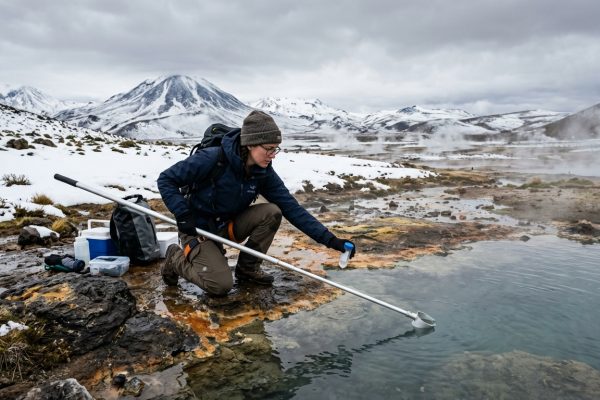
Swissaustral’s Cold-Active Catalase was obtained from an extremophilic microorganism isolated from a Patagonian ice field sample. The enzyme maintains high catalytic efficiency at temperatures as low as 5 °C, according to recent experimental information that is not yet reflected in the current datasheet.
These characteristics position the enzyme for investigation in biosensor systems where low-temperature activity, broad pH compatibility, or refrigerated handling are relevant.
From peroxide control to a more stable biosensor design
When an oxidase-based biosensor shows weak sensitivity, early signal saturation, or a limit of detection that is too high for the target application, peroxide accumulation should be considered alongside electrode and membrane design. Adding an auxiliary catalase can be a relatively focused intervention because it addresses the reaction byproduct without requiring replacement of the base oxidase.
For developers working on conductometric or amperometric glucose, lactate, cholesterol, and related oxidase biosensors, the next step is controlled integration. Compare the oxidase-only and bienzyme configurations under the same conditions, then measure sensitivity, linear range, detection limit, intra-day precision, and operational stability. This approach separates the effect of catalase from the many other variables that determine biosensor performance.
SwissAustral’s cold-active catalase provides a starting point for that evaluation, particularly when low-temperature activity or broad pH compatibility is part of the design brief. Learn more about SwissAustral catalase for biosensor and industrial applications →
References
- Berketa, K., Mruga, D., Dzyadevych, S., and Soldatkin, O. “Development of a new method of improving the oxidase-based biosensors’ analytical characteristics by adding catalase as an auxiliary enzyme.” Electroanalysis 35 (2023), e202300190. https://doi.org/10.1002/elan.202300190
- Berketa, K. O., Mruga, D. O., Dzyadevych, S. V., and Soldatkin, O. O. “Technique for improving the analytical characteristics of biosensors based on enzymes of the oxidase subclass.” Biotechnologia Acta 17, no. 2 (2024): 24–26. https://doi.org/10.15407/biotech17.02.024