Why Leading Textile Mills Are Replacing Sulfite Reducers with Catalase
Residual hydrogen peroxide from cotton bleaching can damage reactive dyes and disrupt downstream finishing. Catalase removes it cleanly — water and oxygen are the only byproducts — and a new broader-range enzyme lets mills skip the rinse-and-adjust step entirely.
Hydrogen peroxide (H₂O₂) bleaching is a cornerstone of cotton and linen processing. Applied at temperatures of 80–100 °C under alkaline conditions, it removes natural pigments and prepares fibers for dyeing and finishing. However, residual hydrogen peroxide left in the fabric or bath after bleaching is far from harmless. Reactive dyes — the most widely used class for cellulose fibers — are vulnerable to oxidative degradation. When H₂O₂ persists into the dyeing stage, it can degrade reactive dyes, reduce fixation, and produce uneven shade and colour inconsistency. Unremoved peroxide can also interfere with downstream finishing steps, affecting overall product quality.
The conventional answer has been either multiple water rinses or chemical neutralization with reducing agents such as sodium thiosulfate or bisulfite. Both approaches add steps, cost, and effluent. The industry needed a cleaner alternative.
How catalase performs bleach cleanup
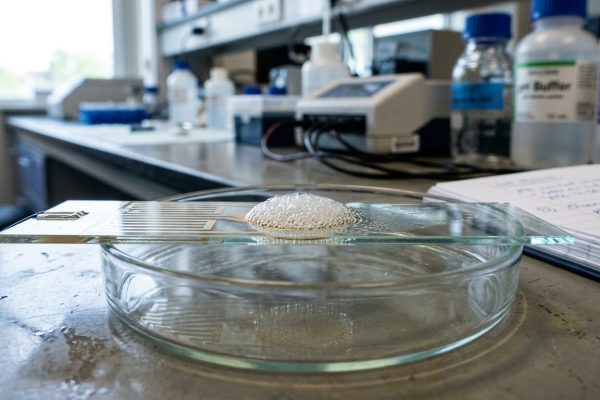
Catalase is an oxidoreductase enzyme that catalyses the decomposition of hydrogen peroxide into water and molecular oxygen:
2 H₂O₂ → 2 H₂O + O₂
This reaction proceeds under mild conditions without adding sulfites, salts, or other chemical residues to the bath. Applied after bleaching, catalase can remove residual H₂O₂ rapidly — typically in a single treatment step — allowing the process to move toward dyeing without the drain-and-rinse cycle required by more conventional methods.
Compared with chemical reduction and repeated washing, catalase-based cleanup can reduce water consumption, shorten processing time, and eliminate the handling burden associated with sulfite-based reducers. Since the only reaction products are water and oxygen, the enzymatic route is also cleaner from an environmental standpoint.
Typical industrial process conditions
Commercial catalase products for textile bleach cleanup are usually applied within a relatively narrow operating window. Across manufacturer recommendations and industrial case studies, the most commonly reported conditions are:
| Parameter | Reported range | Typical optimum |
|---|---|---|
| Temperature | 10–80 °C | 40–50 °C |
| pH | 2.0–10.0 | 5.0–8.0 |
| Treatment time | 10–20 min | – |
| Dosage | 0.05–0.3 % owg | – |
In practice, many textile applications run catalase bleach cleanup at around pH 6.5–8.0 and 30–50 °C, with a treatment time of about 10–20 minutes. Before reactive dyeing, the residual peroxide target is typically reduced to below 2 ppm.
These conditions are effective under controlled mill operations, but they also reveal a key limitation: many conventional catalases work best only within a restricted pH and temperature range.
Why narrow operating windows are costly
This limitation becomes important because peroxide bleaching itself is performed under harsh conditions. Cotton bleaching typically takes place at around 90 °C and under strongly alkaline pH, often close to pH 10–11. In other words, the process that creates the residual peroxide leaves the bath far outside the preferred operating range of many standard catalases.
That mismatch creates cost. Before the enzyme can work efficiently, the bath may need to be cooled, diluted, or chemically adjusted. Cooling consumes time and water. pH correction requires extra chemicals and process control. Additional verification is also needed to confirm that peroxide has been removed before dyeing can proceed.
In a production environment, these are not minor inconveniences. They translate into longer cycle times, more handling steps, higher utility use, and reduced flexibility. A catalase that only performs well in a narrow window can therefore solve one problem while creating another: extra operational cost between bleaching and dyeing.
Our solution: a broader-range catalase
To address these constraints, we offer a catalase designed for a much broader working window. Our enzyme maintains high activity from 20 °C to 70 °C and resists pH values from 4 to 11.
This wider tolerance gives textile processors greater flexibility under real production conditions. Instead of forcing the bath into a narrow enzymatic window, the enzyme can perform across a much broader part of the post-bleach process. That can reduce the need for aggressive cooling, limit pH adjustment steps, and simplify the transition from bleaching to dyeing.
The result is a more practical bleach cleanup process: fewer adjustments, lower utility consumption, and less process interruption. In short, bleach cleanup remains essential — but with a broader-range catalase, it becomes easier to integrate into industrial workflows without turning harsh process conditions into avoidable cost.